best way to learn stock trading from video courses | HoverNotes
GeneralDecember 13, 2025•Updated: July 16, 2026
best way to learn stock trading from video courses
Discover the best way to learn stock trading with a practical plan from core concepts to hands-on practice and proven strategies.
By HoverNotes Team•16 min read
The best way to learn stock trading isn't a secret formula—it's a structured plan that walks you through foundational theory, risk-free practice, and building a system. It’s not about finding a magic pattern, but about building a real, durable skill through a deliberate process.
This approach is designed to get you from understanding core concepts to making informed decisions when the pressure is on.
#Your Practical Roadmap to Mastering Stock Trading
Jumping into trading by watching video courses feels like trying to drink from a firehose. You're hit with endless charts, confusing jargon, and a dozen "unbeatable" strategies all at once. It's overwhelming.
The path to becoming a competent trader isn’t about memorizing every last detail. It's about building a sustainable method that blends solid knowledge with hands-on application. Forget the hype; true skill is built methodically.
This guide gives you an actionable roadmap. We’ll start with mastering the mechanics of the market before you risk a single dollar. From there, we'll move into using simulators to sharpen your decision-making in a safe environment.
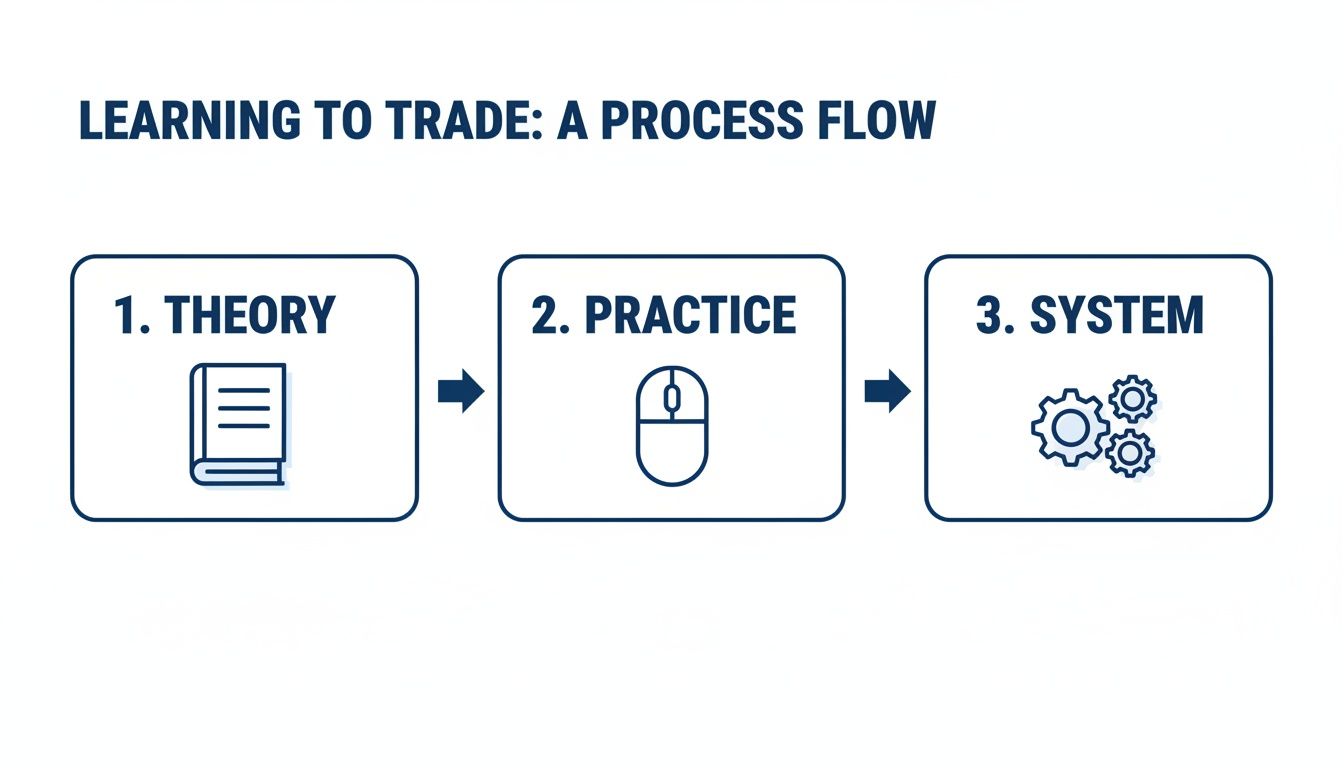
You can think of the whole process in three distinct, connected stages.
This simple flow—from Theory to Practice to System—is the core loop for developing any complex skill, and it’s especially true for trading.
By the end of this guide, you’ll have a clear plan to turn passive video lessons into a practical, repeatable trading ability.
#Building a Strong Foundation with Structured Video Learning
Before you place your first trade, you need to learn the language of the market. This is the non-negotiable first step. Don't skip it.
Forget about complex chart patterns or fancy strategies for now. Start with the basics. What is a stock? How do exchanges work? What’s the difference between a market order and a limit order?
Video courses on platforms like Coursera or Udemy are great for this phase. They’re good at breaking down concepts that are confusing in a textbook, like reading candlestick charts or understanding fundamental analysis.
The goal here isn't to become a Wall Street wizard overnight. It's about building a solid foundation of knowledge that will inform every decision you make from here on out.
Jumping between random "hot stock tip" videos on YouTube is a recipe for disaster. It's a scattered approach that leaves dangerous gaps in your understanding. You might learn one specific pattern but have no clue about the market context that makes it work—or, more importantly, when it's about to fail.
A structured curriculum from a reputable source is far more effective. It guides you through critical concepts in a logical order, starting simple and building up. This systematic approach is the core of learning how to trade because it helps you avoid the costly mistakes that come from knowing just enough to be dangerous.
The big downside to binge-watching trading courses is poor retention. You watch, nod along, but a week later, the information is gone. Manually pausing a video to write notes while trying to capture a complex chart setup on screen is tedious and breaks your focus.
This is where a tool designed for active learning from video helps. HoverNotes is a Chrome extension that watches videos with you, generates AI notes, and saves them as Markdown directly to your file system.
Unlike tools that only parse transcripts, HoverNotes watches the video to capture what's actually on screen. This is a game-changer because it captures crucial visual context—like the exact shape of a breakout pattern on a chart—that an audio-only tool would miss.
Here’s what that looks like in practice:
Timestamped Screenshots: See a perfect chart setup? One click grabs a screenshot. Later, click that image in your notes to jump right back to that exact moment in the video.
Local-First Ownership: Your notes save as .md files directly to your machine, perfect for an Obsidian vault. You own the files. Move them, back them up, grep them—they're just Markdown.
Active Recall: You're no longer just passively watching. You’re actively building a personal, searchable library of trading strategies and market concepts.
A system like this transforms you from a passive viewer into an active learner. We have a detailed guide on how to learn effectively from Udemy videos that you can apply to any platform. You can try HoverNotes for free—even without AI, the one-click screenshots and distraction-free mode are useful for staying focused.
#From Knowing to Doing: Get Your Hands Dirty with a Simulator
All the books and videos in the world won't prepare you for real trading. Knowledge is just theory until you apply it. This is where paper trading and stock market simulators become the most important part of your education.
These platforms are your risk-free sandbox. You trade with virtual money in a live market. It's the perfect place to build the muscle memory you'll need when your own capital is on the line.
Here, you can test that strategy you saw on YouTube, experiment with different order types, and feel the impact of a losing trade—all without any financial damage. The point is to make your rookie mistakes when they cost nothing.
This is the gap that separates passive learning from true skill-building. It's the difference between watching a tutorial on how to swim and actually getting in the water. One is just information; the other is genuine experience.
Using a simulator is much more than just clicking buy and sell. It's a targeted training ground for developing the fundamental skills every trader relies on. The table below breaks down the key skills you'll build and why a simulator is the best place to learn them.
Skill
Why Simulation is Essential
Order Execution
You'll learn the real difference between market, limit, and stop-loss orders by seeing how they execute in a fast-moving market.
Risk Management
This is where you practice sizing your positions and setting your stops before the fear of losing real money clouds your judgment.
Emotional Control
Even with fake money, you'll feel the sting of a losing streak and the rush of a win. It's a safe space to manage those emotions.
Strategy Testing
The simulator is your lab. Test new ideas across different market conditions to see if they hold up under pressure.
This process of learning and immediately applying is a powerful feedback loop. It's the same active learning method developers use when learning from coding videos—they don't just watch; they pause, grab snippets, and run the code themselves.
For traders, simulators provide that exact same hands-on, immediate feedback. It’s an absolutely essential step in your journey.
#Building a System for Continuous Learning from Videos
The markets never sit still. Learning to trade isn't something you do once; it's a continuous process. Videos are a great way to keep up, but passively watching hours of tutorials is one of the worst ways to learn. Without active engagement, we forget most of what we see.
The trick is to build a system for active learning. The old way is clunky. You're constantly pausing to write notes, fumbling with screenshot tools to grab a chart pattern, and then trying to make sense of it all later. It kills your focus. This is where tools designed specifically for learning from video make a difference.
The best way to learn stock trading from video is to stop being a consumer and start being a creator. Your goal should be to build your own personal library of strategies, concepts, and chart examples that you can review.
This means you need a workflow that captures not just what the instructor is saying, but what they are showing. In trading, the visuals are everything—the specific shape of a head-and-shoulders pattern, the exact settings for a moving average, the way volume explodes during a breakout. A simple text transcript misses all of that crucial context.
The goal is to create a personal, searchable knowledge base you own forever. This isn't just about passing a course; it's about building a reference library that will serve you throughout your entire trading career.
A Chrome extension like HoverNotes can watch videos alongside you, generating AI notes and capturing the critical visual data. Unlike tools that just rip a transcript, it analyzes the video frame-by-frame. This ensures it catches the visual context of a trading indicator or price pattern—the stuff that actually matters. This active capture process is the bridge between passively watching and truly understanding.
A good learning system has to be efficient and fit into your existing routine. The notes you take should be painless to create, easy to organize, and even easier to find later.
This is where local-first tools and plain text formats shine. Instead of locking your knowledge in a proprietary cloud service, a system that saves your notes as local Markdown files gives you total control.
You can save them directly to an Obsidian vault, for instance, and start building a deeply interconnected, searchable library of trading strategies. Because you own the actual .md files, your knowledge is permanent and portable.
Here are a few features that make a system like this work:
Timestamped Screenshots: Instantly grab any chart, diagram, or indicator setup. Every screenshot includes a clickable timestamp—one click returns you to that exact moment.
Snip Capture: Don't need the whole screen? Snip just the code snippet or diagram you need and embed it directly into your notes.
Distraction-Free Mode: Many learning platforms are designed to distract you. A focused video mode that blocks the noise and puts your notes right next to the content is vital for staying in the zone.
This kind of system turns passive viewing into an active process of creating and retaining knowledge. If you want to see this method in action, our article on turning a YouTube video into notes lays out a practical workflow. Notes copy cleanly into Notion if that's where you keep everything.
You’ve put in the time with courses and spent hours in the simulator. Now it’s time to graduate from practicing to planning. This is where you build your personal trading strategy—your non-negotiable rulebook for the market.
Once you have a draft of your plan, the next step is backtesting. This is where you take your new rules and apply them to historical market data to see how they would have performed in the past.
Past performance doesn't guarantee future results. But backtesting is the closest thing you have to a data-driven stress test. It systematically strips emotion and guesswork out of your trading, forcing you to operate on probabilities and statistics instead of hunches. The goal isn't perfection; it's to find a strategy with a demonstrable statistical edge over time.
This hands-on, data-driven work is what separates amateurs from serious traders. A study from the Tallinn Stock Exchange found that investors with stronger academic results were also more active traders, making an average of 20.48 trades compared to 17.4 by others. Why? Because that active experience is how you refine your skills. A disciplined approach to testing your strategy is fundamental to real improvement. You can explore more on the connection between education and trading activity in the full study.
Don't treat your first trading plan like it's carved in stone. It’s a starting point, a living document that you should update continuously based on your performance and ongoing learning. As you gather more data from your trades—both simulated and real—you'll spot weaknesses and find areas for improvement.
This cycle of testing, trading, and refining is the core of the learning process. Documenting your strategies, setups, and results is a powerful form of personal knowledge management. You’re turning your experiences into a structured, reusable asset. Building this kind of system is crucial for long-term growth, and you can learn more about crafting one in our guide to personal knowledge management software.
Backtesting isn't about finding a perfect system. It's about understanding the probabilities of your chosen strategy and building the discipline to execute it consistently, even when it feels uncomfortable. Your rulebook is your anchor in the emotional chaos of the market.
#Making Your First Real Trades and Managing Psychology
You've put in the hours, found a consistent edge in the simulator, and your backtesting data looks solid. Now comes the moment of truth: putting real money on the line.
This is where the real education begins, and it has little to do with charts and everything to do with what’s going on between your ears.
When you go live, start small. Absurdly small. The goal of your first few hundred live trades is not to make money. It’s to feel the pressure of having your own capital at risk. That's a feeling no simulator can replicate.
The moment real money enters the picture, two powerful emotions hijack your brain: fear and greed. They will team up to obliterate your carefully crafted trading plan.
Suddenly, the urge to bend your rules becomes overwhelming. You'll be tempted to hold that losing trade just a little longer, hoping it will turn around. Or you'll snatch profits off the table way too early on a clear winner because you're terrified of giving anything back.
This is the crucible. Your long-term survival depends entirely on your ability to execute your rules with cold, unfeeling discipline.
Professional traders don't win every trade. Their secret is that they manage their losses with brutal efficiency. One big, emotionally-driven loss can wipe out the profits from a dozen disciplined wins. Your job isn't to be right; it's to be disciplined.
Your single most important tool in this phase is your trading journal. It’s not just a logbook; it’s your personal performance coach. For every trade, document the cold, hard facts:
Your Rationale: Why did I enter this trade? What was the setup? What rules did it meet?
The Outcome: The profit/loss, but also how the trade played out.
Lessons Learned: This is the gold. How did you feel? Did you follow your plan? Where did you hesitate or make a mistake?
This journal is the data that will expose your bad habits and emotional triggers. It’s your mirror.
If you start seeing a pattern—like consistently widening your stop-loss because you can't stand taking a small loss—that’s a huge red flag. It’s a signal to stop trading with real money. Go back to the simulator and drill the process of executing your plan flawlessly until it becomes second nature.
Think of it not as a step backward, but as a crucial part of forging the discipline you need to survive in the markets.
Getting your bearings in the trading world can feel like learning a new language. It’s natural to have questions. Let’s tackle some of the most common ones.
There’s no magic number here. It comes down to how much focused effort you put in. Most people will need a few months just to get the hang of the terminology and feel comfortable with their trading platform.
But to reach consistency? We're talking years. This isn't a weekend course. The best mindset is to see trading as a craft you’re honing for the long haul, not a finish line you cross.
I’ve seen traders with mediocre strategies but rock-solid discipline run circles around brilliant analysts who can't control their emotions.
Discipline is your ability to stick to the plan. It's cutting a losing trade without a second thought because your rules told you to. It's sitting on your hands when there's no good setup, even when you're bored. Taming your own psychology is a tougher fight than outsmarting the market.
#Should I Learn Fundamental or Technical Analysis?
Both. They're two different tools for two different jobs, and most seasoned traders use a blend of the two.
Fundamental Analysis answers the “what” question. It helps you dig into a company’s health to decide if it's a stock you even want to own.
Technical Analysis answers the “when” question. It’s about reading charts to find entry and exit points based on price behavior.
Getting a grip on the basics of both will make you a far more versatile trader. If you're sifting through educational videos on these topics, our guide on using an AI video summarizer can help pull the key lessons from long, dense tutorials without having to re-watch them multiple times.
P.S. If you're an Obsidian user, HoverNotes is designed to save your notes directly into your vault as clean, organized Markdown files. You can give it a try for free—we include 20 minutes of AI credits to get you started, no credit card needed. Learn more at https://hovernotes.io. Confirm current options on the HoverNotes pricing page.
Learning the mechanics of trading is not evidence that a strategy will be profitable. The U.S. Securities and Exchange Commission warns that day trading can produce severe losses, involves substantial costs, and should not be funded with money needed for living expenses. FINRA's required day-trading risk disclosure likewise says the strategy is generally inappropriate for people with limited resources, limited experience, or low risk tolerance. Use courses and paper-trading tools to learn vocabulary, order types, risk controls, and record-keeping—not as proof of easy returns. Verify any broker, educator, and performance claim independently before committing capital.
Struggling with MOOC note taking on Coursera or edX? Learn a proven workflow to organize, retain, and apply knowledge from long courses without the burnout.