Why Developers Are Ditching Traditional Note-Taking for AI Learning Companions | HoverNotes Blog | HoverNotes
Developer ProductivityMarch 10, 2025
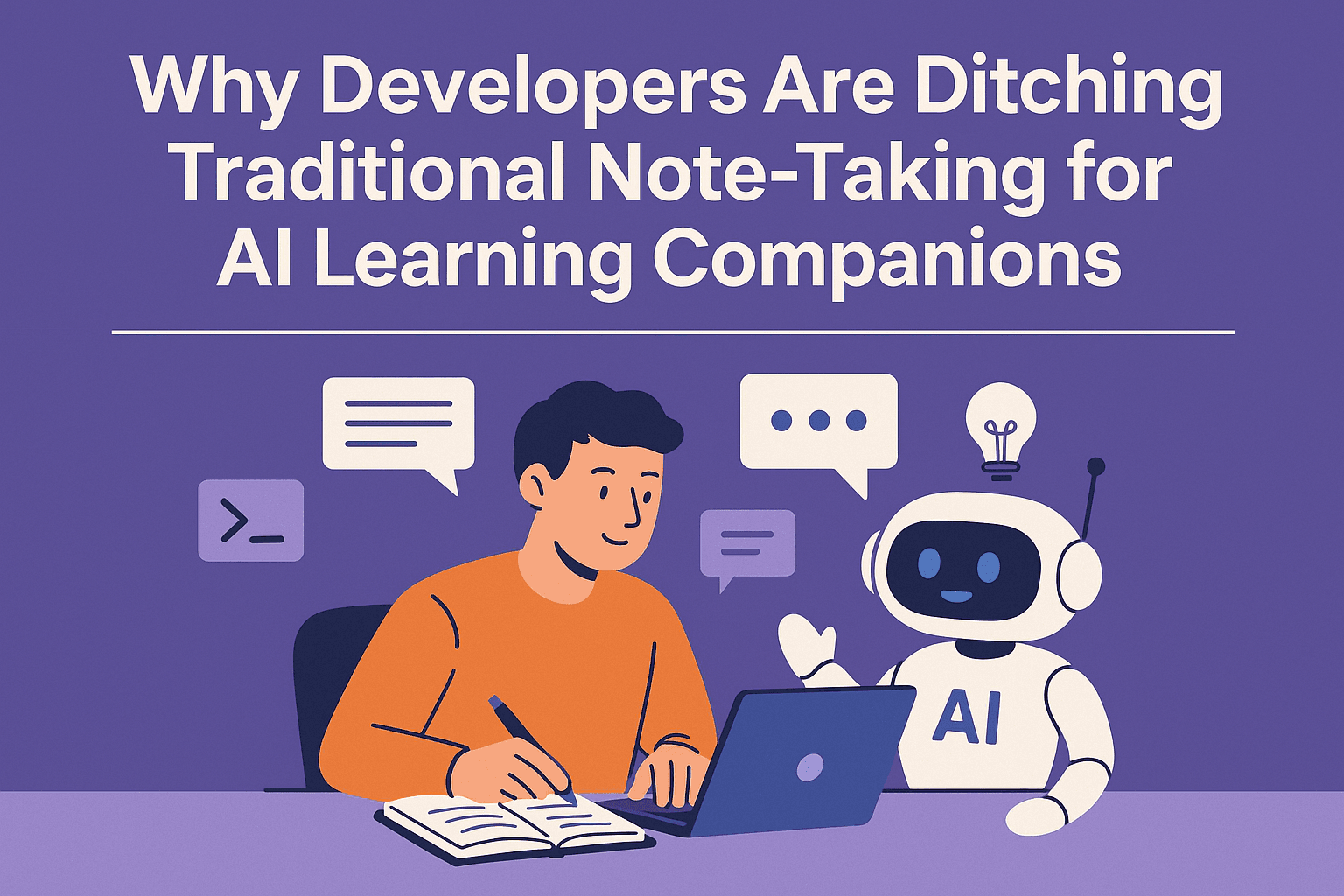
Why Developers Are Ditching Traditional Note-Taking for AI Learning Companions
Explore the shift to video documentation for developers, highlighting essential tools and strategies to enhance knowledge sharing and team efficiency.
By HoverNotes Team•8 min read
#Why Developers Are Ditching Traditional Note-Taking for AI Learning Companions
The way we learn from videos is broken. You watch a brilliant tutorial, think "I'll remember this," then find yourself rewatching the same content weeks later, desperately scrubbing through timestamps to find that one crucial insight. This inefficiency isn't just frustrating—it's a fundamental barrier to knowledge retention in our video-first learning era.
The solution isn't better video creation tools. It's learning tools that transform passive video consumption into active knowledge acquisition.
: Developers spend an average of 23% of their time rewatching tutorials they've already seen, according to recent Stack Overflow surveys. The human brain simply isn't optimized for retaining complex technical information from passive video consumption. Studies show that visuals are processed 60,000x faster than text, yet traditional learning tools fail to capitalize on this advantage.
The Rewatch Trap
Context Loss: Traditional note-taking requires constant pausing, switching between windows, and manual transcription. By the time you've written down a code snippet, you've lost the context of why it matters. Users spend 47% more time on interactive content compared to passive consumption, highlighting the need for tools that bridge this gap.
Knowledge Silos: Even when we do take notes, they often end up scattered across platforms—Google Docs, Apple Notes, random text files—making them impossible to search or connect to other knowledge.
Stop passive video consumption. HoverNotes watches with you, understands visual context, extracts code snippets, and builds local knowledge that you own.
The breakthrough isn't in creating better videos—it's in creating tools that watch videos with you. Unlike transcription-based tools that only capture spoken words, modern AI can understand visual context, extract code from screens, and identify the relationships between concepts as they unfold.
Traditional note-taking tools rely on transcripts, missing crucial visual information. When an instructor writes code on screen, draws a diagram, or demonstrates a UI interaction, transcript-based tools capture only the narration, not the implementation.
AI learning companions powered by computer vision can:
Extract code snippets directly from video frames with proper syntax highlighting
Capture diagrams and architectural drawings automatically
Understand the relationship between what's said and what's shown
Generate context-aware explanations that combine visual and audio information
The most innovative learning tools are embracing a local-first approach, giving users complete control over their knowledge while still providing AI-powered insights.
Privacy: Your learning notes contain sensitive information about your skill gaps, interests, and professional development. This data should belong to you, not a cloud provider.
Ownership: When your notes live in proprietary cloud systems, you're one acquisition or policy change away from losing access to your knowledge base.
Integration: Knowledge workers already have preferred systems—Obsidian, Notion, or simple markdown files. The best tools integrate with existing workflows rather than forcing platform switches.
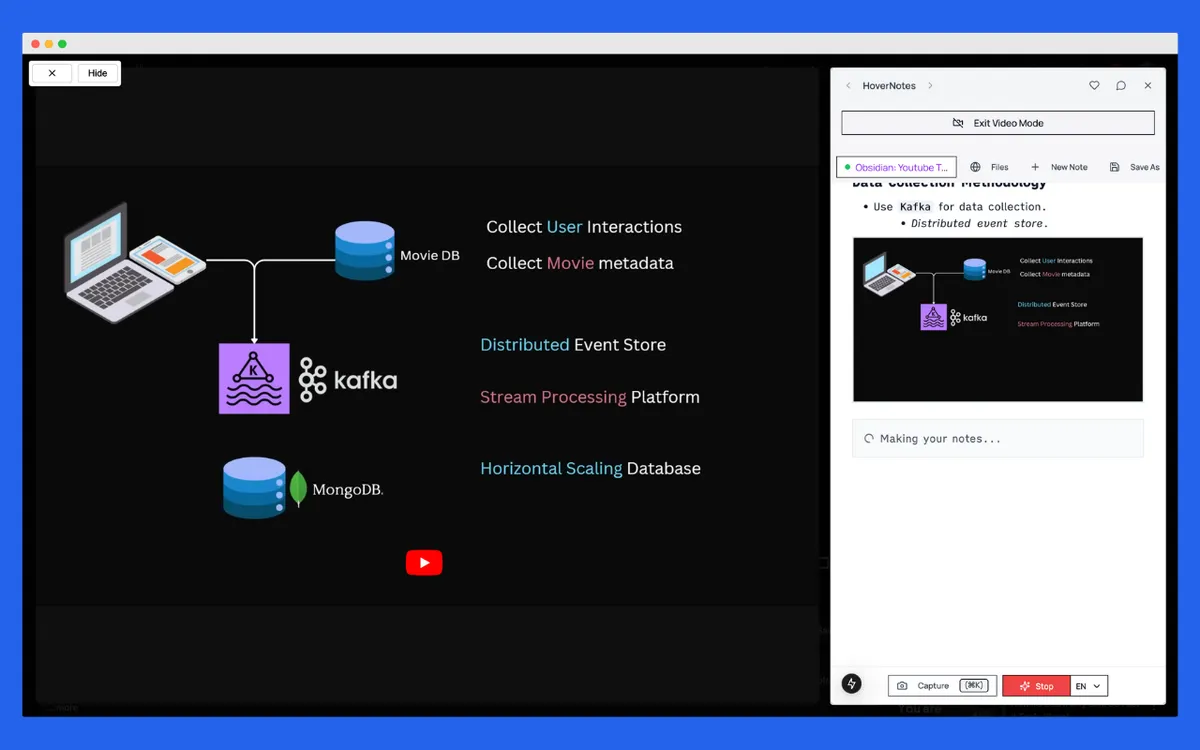
HoverNotes represents this new category of AI learning companions. Instead of creating another cloud-based note-taking platform, it processes videos locally and exports directly to your chosen knowledge management system.
Core Innovation: The AI watches videos in real-time, understanding both visual and audio content to generate structured notes that capture:
Code implementations with syntax highlighting
Screenshots at key moments
Concept explanations in over 15 languages
Links between related ideas
Local-First Design: Everything processes in your browser and saves directly to your Obsidian vault, Notion database, or local markdown files. No cloud storage required.
Universal Compatibility: Works with YouTube, Udemy, Coursera, or internal company training materials.
Jira Integration: Teams can attach video recordings directly to Jira issues, updates, and comments. This works well for bug reports with visual reproductions, explaining code reviews, feature walkthroughs, and sprint summaries.
Start Local: Build local-first with optional cloud features, not the reverse. Users will trust you more and you'll differentiate from cloud-only competitors.
Focus on Integration: Don't build another knowledge management platform. Build the best possible integration with platforms users already love. According to Vimeo's research, "The trick to a successful Video Library? Ruthless organization."
Charge for Value: Price based on AI processing and advanced features, not storage. Storage is a commodity; intelligence is valuable.
Embrace Tool Choice: Let employees use their preferred learning and knowledge management tools. Standardization often reduces adoption. Studies show that employees spend up to 19% of their workweek searching for information, highlighting the importance of good organization systems.
Invest in Learning Infrastructure: The tools that help your team learn faster provide exponential returns on productivity and innovation.
Measure Knowledge Retention: Track not just course completion but actual application of learned concepts in real work.
The learning revolution is happening now. Whether you're a student, developer, or knowledge worker, the tools exist today to transform how you acquire and retain knowledge from video content.
For Individual Learners:
Choose tools that integrate with your existing workflow
Prioritize local storage and data ownership
Focus on active learning features over passive consumption
For Teams:
Experiment with AI learning companions for training materials
Create shared knowledge bases from video learning
Measure retention and application, not just completion
For Tool Builders:
Solve learning, not just note-taking
Respect user data ownership and privacy
Build for integration, not platform lock-in
The future belongs to tools that make us smarter, not just more organized. The video learning revolution is just beginning—and the winners will be those who put learners in control of their own knowledge.
Ready to transform your video learning? Explore tools like HoverNotes that put AI learning companions and local-first design at the center of the experience.